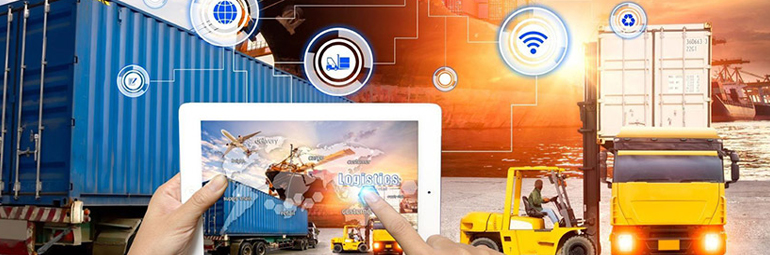
It is obvious that technology has progressed at the same pace as the years have flown by, and the use of the internet has become more common with the development of technology. Taking advantage of this expansion, various commercial institutions have started to offer their customers applications where they can shop online, and an e-commerce culture has emerged.
As years pass quickly, it is evident that technology is advancing at the same pace, and with the development of technology, the use of the internet has become more widespread. Taking advantage of this expansion, various commercial institutions have started offering applications that allow customers to shop online from where they sit, leading to the emergence of e-commerce culture. Institutions engaged in e-commerce have begun striving to deliver the products and services purchased by customers in a fast and reliable manner, and thus the concept of e-logistics has emerged.Customers who shop via e-commerce expect the products they purchase from websites to reach them quickly and safely, largely due to habits formed from traditional shopping culture. In this context, e-commerce sites establish various procedures and applications in advance, such as specifying the estimated delivery date of orders, in order to create incentives for shopping. Therefore, in the time period from online ordering to shipping and finally delivery to the customer, significant investments are made in e-logistics to ensure customer satisfaction and to manage this entire process efficiently.What is Digital Transformation?
Digital transformation is a holistic approach that integrates digitalization into all business processes as information and services rapidly incorporate technology and society adopts these developments. Digital transformation in logistics refers to the shift toward digital and mobile systems across all processes within the sector, providing significant benefits by eliminating many inefficiencies in the logistics process.For example, insufficient use of logistics and transportation capabilities in the supply process not only causes efficiency problems but also disrupts the connection between systems. Therefore, e-logistics applications provide significant advantages in preventing such negative situations. With the increasing adoption of e-commerce culture, concepts such as speed, efficiency, and timing have become essential, and thus the concept of e-logistics has gained rapid momentum in recent years.E-Logistics Applications
The processes of e-logistics applications can be listed as follows:Order process
Purchasing
Warehousing
Stock planning and control
Transportation management
Demand forecasting
Packaging and loading
Recycling
Customer service
Other servicesDifferences Between E-Logistics and Traditional Logistics
Customers who shop online expect a unique level of speed and service management. Therefore, the order process and shipment carried out with a single click on the internet, as well as the physical delivery of the product to the customer, make logistics a significant part of e-commerce. As a result, demand for e-logistics has increased significantly, and the differences between e-logistics and traditional logistics have become a major topic of discussion.The differences between e-logistics and traditional logistics are as follows:In e-logistics, all processes are monitored through information systems, whereas in traditional logistics these processes are carried out manually.
In e-logistics, shipped products are generally smaller in scale and transported by smaller vehicles. In contrast, in traditional logistics, the products shipped are larger in scale and require larger transport vehicles.
In e-logistics, product values generally do not fall within high price ranges, whereas in traditional logistics, the value of transported goods is higher.In conclusion, this relatively new concept increasingly integrated into our lives primarily focuses on customer satisfaction. Traditional logistics has begun adapting to digital transformation across all business processes alongside technological development and has implemented various applications in this direction. Therefore, as we are currently living in the age of technology, it is clearly observed that with the increasing demand in e-commerce, there has also been a rise in e-logistics applications.Horoz Lojistik, which has been providing professional services in the logistics sector since 1942, also applies all its experience in the field of e-logistics. Continuing its success in traditional logistics within e-logistics as well, Horoz offers the opportunity to track the entire process through special software. You can start benefiting from advanced e-logistics solutions by contacting Horoz Lojistik.




 Product Shipping Only
  Assembly & Disassembly
  Product Shipping + Assembly & Disassembly
  Order Tracking